

Types of poker: What is played in casinos and beyond


One of the most common misconceptions about poker is that it is one single game where different players decide the rules they want to adopt. However, nothing is farther from the truth. Poker really is a family of different game variants but with a fundamental shared principle: to play the best hand or bluff your way to victory.
Betting, hand combinations, and strategic decision-making are pretty much the same in all variants, but other gameplay aspects, like rules, pacing, and depth, differ across other types of poker. Additionally, some versions, like Texas Hold’em, are better suited to professional tournaments, while others cut across regular casino play and casual home gaming.
Regardless of which variant you find yourself playing, though, it’s almost certain that you’ll be challenged to read the situation while trying to outsmart your opponents. In this guide, we help you understand the popular types of poker, what makes each one unique, and where they are typically played.
It’s worth remembering that poker is only one of a long list of exciting, adrenaline-pump games available at casinos. For a refresher on the main types of online casino games, you can check out our one-stop guide to casino gaming here.
Articles Worth Reading
Main (tournament) poker games
Over the years, poker has evolved quite significantly, and one of the many improvements to the game is the introduction of global tournaments. Today, thousands of skilled players can compete against one another for a shared prize pool, often running into millions of dollars. Some good examples of cut-throat poker championships include the World Series of Poker (WSOP) and the European Poker Tour (EPT).
As you must have guessed, these tournaments call for the most challenging and iconic poker game variations. Interestingly, only a handful of poker types fit this specification, and they are Texas Hold’em, Omaha, and Stud. It’s therefore not surprising that these formats have grown to be the most popular across the world.
In the sections that follow, we discuss details about each of the variants and what every aspiring poker champion should know about them.
Texas Hold'em poker
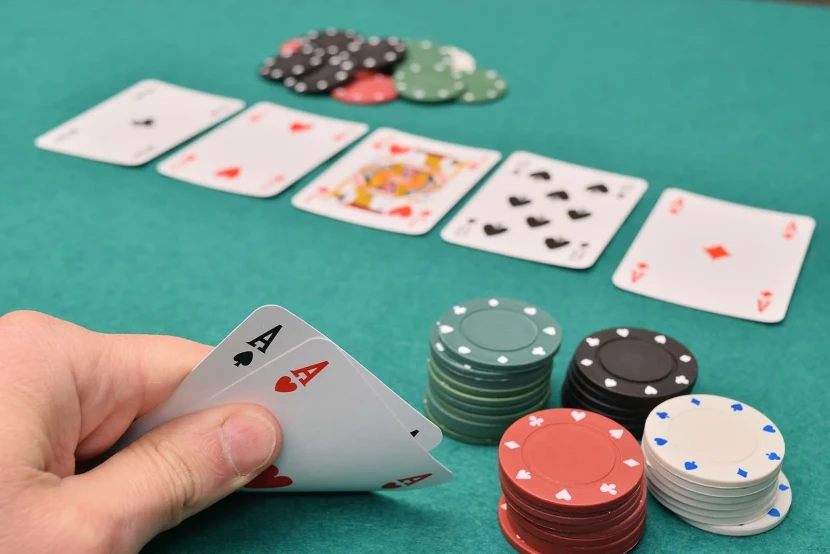
The Texas Hold’em variation rose to global prominence, thanks to its use in televised poker tournaments and the poker boom of the early 2000s. It now stands as the world standard for competitive poker gaming. A perfect combination of excitement and strategic thinking, Texas Hold’em is the perfect option for players who favor a mix of luck and skill.
Many believe that Texas Hold’em is the simplest format out there, but tournament participants would most likely beg to differ. The variant is adopted in major tournaments like the WSOP, the EPT, and the World Poker Tour.
Like most variants in this category, the Texas-styled game relies on a 52-card French deck with play following a clockwise rotation. At the core, Texas Hold’em is a community-card poker game, and this means players aim to combine their hole cards with community cards to build the best five-card hand possible.
Each player is initially dealt hole cards, which are simply two cards face down. After multiple betting rounds, players are further dealt five more cards facing up (community cards) across three stages. If all other players fold during the betting rounds, the only player to not fold wins the pot. However, if all players remain in the game, the contestant with the best hand wins.
Texas Hold'em rules
After the sneak peek above, you’re probably wondering how to play Texas Hold’em poker like a pro. Well, there are five stages involved in Texas Hold’em. Below is a rundown of how each of them works:
- Pre-flop: In this phase, players are dealt the hole cards, after which the two players to the left of the dealer make small blind and big blind bets to start off the betting round.
- The flop: Here, community cards are shared among the players, and they can decide to check, bet, call, raise, or fold.
- The turn: A fourth community card is dealt in the stage, but this time, the card is face up. Another betting round follows as in the previous phases.
- The river: This is where the fifth and final community card is dealt to players. Accordingly, the fourth and final betting round takes place.
- Showdown: Players reveal their hands, provided they have not folded previously in the betting rounds. The player with the best five-card hand wins, regardless of how the hand is built.
One important point worth noting in Texas Hold’em is that you can decide to use or not use your hole cards.
Omaha poker

What is Omaha poker? Well, if Texas Hold’em is famously the king of poker, then Omaha is its action-packed cousin. The two games share a lot of important features in common, ranging from the use of community cards to similar hand rankings and even the same sequence of betting rounds.
However, where they differ is that Omaha adds a unique twist to the gameplay style. In Omaha, each player is dealt four hole cards instead of two. But unlike Texas Hold’em, where your five-card combo can come from any of the cards, in Omaha, you must use two hole cards and three community cards.
The good thing about this rule is that it guarantees the players access to more cards, and with more cards, the chance of hitting stronger combinations increases. In fact, in many tournaments, what may win the game in Texas Hold’em would seriously fall short in Omaha.
Within the Omaha variant, there are two different variations, namely the Omaha Hi (or Pot-Limit Omaha) and the Omaha Hi-Lo. In the former, the highest hand takes home the entire pot. Albeit in Omaha Hi-Lo, or sometimes the Omaha Eight or Better, the pot is split between the highest and lowest qualifying hands.
Omaha rules
Up next in this section, we explore how to play Omaha poker. For starters, it’s important to remember that players in this poker variant are dealt four hole cards face down at the start of the deal. But like Texas Hold’em, they are dealt five community cards across three stages. Here’s a look at the different phases involved in a classic Omaha game:
- Pre-flop: The four hole cards are dealt here, with the player to the left of the big blind kicking off the action in what is known by poker players as Under the Gun (UTG).
- Flop: Here, three community cards are initially dealt face up, and action continues on the table in a clockwise rotation.
- Turn: Players are dealt their fourth community card, and bet sizes change remarkably, depending on the betting system employed.
- River: This is the fifth and final community card to be dealt, also signifying the last betting round. If there is more than one player after the river, a showdown occurs to determine the winner.
Again, in Omaha, the best five-card hand wins, but the winner must use exactly two of their hole cards and three community cards.
There are different betting formats in this variant, namely the Pot-Limit, No-Limit, and Fixed Limit. In the Pot-Limit system, players bet or raise to match the current size of the pot, while in the less-common Fixed Limit, bets and raises are fixed and capped by the table limits. Similarly, the No-Limit betting style, from the name, implies that players are free to bet any amount.
7-Card Stud
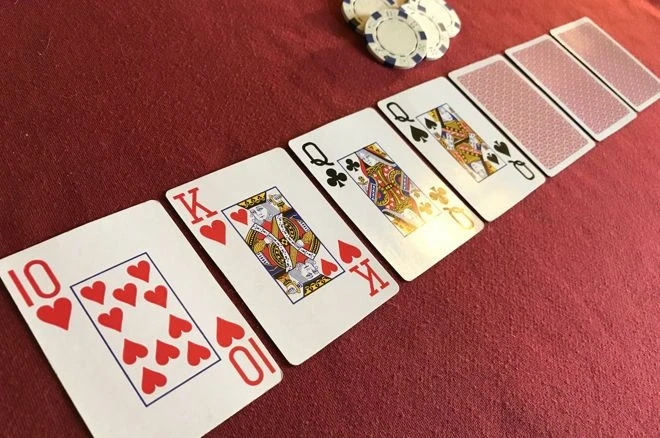
Still on tournament poker variants, 7-Card Stud is one variation that has featured in many major poker championships across the world in the last decade. The 7-Card Stud predates Texas Hold’em and operates without a pre-flop betting round. There are no shared community cards. Instead, players are dealt a combo of hole cards and face-up cards (door cards).
Ultimately, players are dealt a total of seven cards across multiple betting rounds, with the best five-card hand emerging as the winner. In the 7-Card Stud, since most cards are visible, memory and observation are two important assets. The game rewards competitors who can track folded hands and read their opponents.
Also, the game variant adopts a no-limit betting system by default, although spread and pot-limit versions of the game exist. In addition, there are no blinds, and each hand starts with an ante, followed by a forced bring-in bet.
7-Card Stud rules
This poker type follows a pretty structured sequence. And since there are no blinds, the game automatically begins with an ante posted by all players. That said, here are the five betting rounds through which the poker game progresses:
- Third Street: Here, each player is dealt two hole cards and one door card. Afterward, the player with the lowest door card makes the bring-in bet. Betting continues in a clockwise rotation from the bring-in bettor.
- Fourth Street: Every player receives a second door card. Starting from this stage, the player with the best visible hand takes action first, while ties are broken by suit rankings.
- Fifth Street: During the fifth street, another door card is dealt, bringing the total number to three per player. Betting typically increases at this level.
- Sixth Street: A fourth door card is dealt, and betting continues at the higher limit.
- River: Sometimes called the Seventh Street, every player receives a final hole card, and with a total of seven cards, the final betting round occurs. If two or more players remain at the table, a showdown takes place.
The winning hand in the Seven Card Stud variant is determined by standard poker hand rankings. And where two or more players have equal hand strength, the pot is divided among the winning players.
Don't Miss Out
Casino poker games
There is a massive world of difference between tournaments and casino-styled activity. While one is designed for professional competition and a fight-to-the-finish approach, the different types of casino poker games are tweaked for speed and mass appeal. So, in this poker type, players pit against the house like in other casino table games like baccarat or blackjack, but never against each other.
As a result of the house-banked focus, there’s almost zero bluffing or positional play. With players simply trying to beat the casino dealer’s hand, there’s no need to evoke psychological methods like low rolling, trapping, or bluffing. Also, casino poker uses standardized paytables, thereby guaranteeing an almost fixed payout each time compared to prize pots in contests.
Moreover, as you’ll see, casino-style poker adopts more simplified gameplay rules, making it the perfect option for casual players who want to keep things moving quickly. And as part of a casino’s promotional features, there are usually side bets, progressive jackpots, and other potential rewards for players.
One good aspect of every casino poker game is their accessibility. These game variants are widely available in land-based casinos and online live dealer platforms. When playing online, you get to enjoy a sleek interface, real-time interaction with croupiers, and integrated side bets, among many innovations.
Caribbean Stud poker
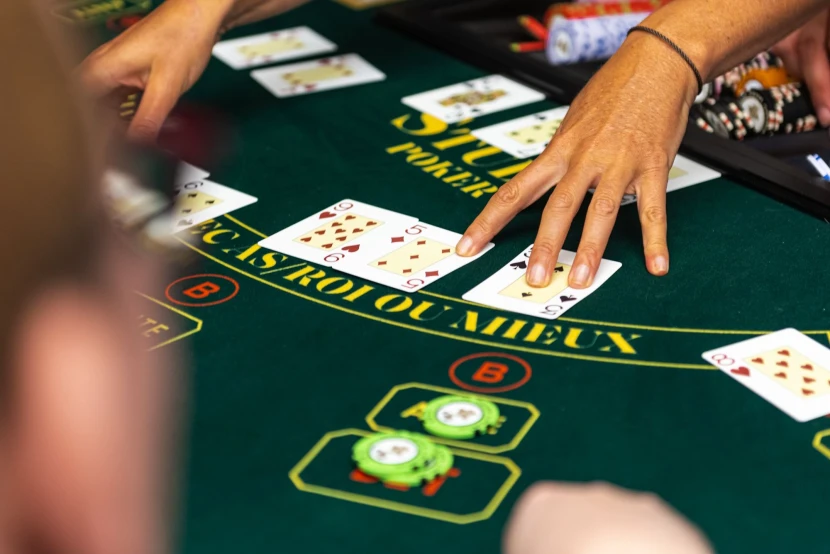
Perhaps the most popular type of casino poker, Caribbean Stud, is a five-card game played against the dealer. Unlike competitive poker variations that call for complex strategy and reading of opponents, the Caribbean Stud is rather streamlined, focusing more on quick gameplay and minimal decision-making requirements.
A defining feature of the game is the progressive jackpot side bet. While optional, this feature makes you eligible for massive payouts if you’re willing to sacrifice just a small extra wager. The game starts with an ante bet, after which the player and the dealer both receive five cards.
One of the dealer’s cards is usually revealed while the player’s hand stays face down throughout the round. The player may decide to fold or raise after the cards are dealt, depending on the quality of their hand. Subsequently, the dealer reveals his full hand but can only proceed to the next stage if he has at least an Ace-King high.
While the origins of Caribbean Stud poker are hotly debated, the most widely accepted theory is that the game was first played on Caribbean cruise ships back in the 1980s. At that point in history, it was called “Casino Stud poker,” perhaps to indicate its suitability for casual players.
Caribbean Stud rules
Next up, let’s discuss how to play Caribbean Stud poker. Luckily, the poker variant is quite simple to understand, thanks to its historically straightforward design. An important point to note about this poker variation is that there are no clearly defined stages or phases like in competitive poker.
Instead, the round begins with the ante bet, and every other activity flows seamlessly. Notably, after cards are dealt and the player has a chance to view their own, they can either fold and lose the ante bet or raise by placing an additional bet to double the ante. It is at this point that the dealer goes on to reveal their full hand, thereby determining qualification.
Should the dealer qualify and beat the player, all bets are lost. However, if the dealer doesn’t qualify, the ante bet pays out to the player. In an alternate instance where the dealer qualifies but the player wins, the ante bet pays 1:1, and the raise is paid to the client.
For players who placed a progressive jackpot side bet after the ante, there is the option to win fixed bonus payouts. These payouts remain the same, regardless of the dealer’s hand. So, even if the player folds or loses the main hand, as long as they show a jackpot-eligible hand, they’ll get paid. Examples of jackpot-eligible hands are a royal flush, straight flush, four-of-a-kind, full house, or a flush.
Casino Hold'em

Ever wondered what it would seem like if the Texas Hold’em variant were adapted for casino gaming? Well, look no further than Casino Hold’em. Originating in the late 1990s, the Casino Hold’em was designed to train players for the more complicated Texas variant. It would later find its way to casinos at the turn of the century.
Safe to say, Casino Hold’em is simply the Texas Hold’em game transformed into a player-versus-dealer format. It retains the community card structure of the traditional Texas Hold’em but makes decision making quite simpler to accommodate the demands of casino tables.
However, like the Casino Stud we earlier discussed, Casino Hold’em makes room for an optional AA bonus side bet. Similarly, the game here begins with an ante bet and has dealer qualification requirements.
Casino Hold'em rules
Although the Casino Hold’em video poker is pretty straightforward, many players struggle to understand the gameplay, considering that it combines features of different poker variants. That said, here’s a quick look at how the game works, including some details on its side bet.
Ante bet and side bet
The game starts with an ante bet, but players are allowed to place an AA bonus side bet. The side bet is paid out based on the first two hole cards and the three-card flop dealt to a player.
Deal the cards
Both the dealer and the player receive two hole cards each. Afterward, the dealer deals three community cards. You can decide to fold or call (double your ante with a call bet) at this point in the game.
Complete the board
If you call, the dealer deals cards similar to the turn and river stages in Texas Hold’em, bringing your community card total to five. The dealer then reveals their two hole cards for you to see.
Dealer qualification
To qualify, the dealer needs to have at least a pair of 4s. If the dealer does not qualify, your ante bet is paid out, and your call bet, if any, is returned. However, should the dealer qualify while beating your hand, you lose out on every bet made. Alternatively, if the dealer qualifies but your hand wins, your ante and call bets are both paid out. If there is a tie, both bets are returned.
Three Card Poker
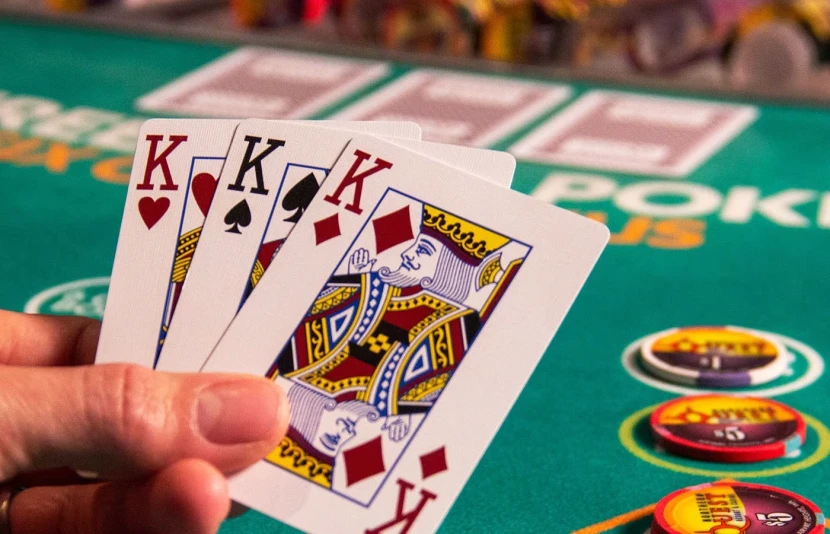
Arguably the simplest and fastest-paced casino poker out there, Three Card Poker has grown to become a remarkable player favorite all around the world. It’s best suited to casual players or even some pros who are looking for some quick casino option. However, it’s worth noting that this variation does away with lots of traditional poker rules.
The Three Card Poker draws inspiration from the British card game Brag. Derek Webb is often credited with adapting the game to an American audience, coincidentally creating what is now known as Three Card Poker.
One of the perks of Three Card Poker is the low skill barrier for entry. Think of slots and how easy they are to play without much prior knowledge. Well, Three Card Poker promises a similar experience.
Here, you are dealt three cards and choose right away to play or fold without the usual complexity of opponent reading or multiple playing rounds. That said, we will discuss how to play 3 Card Poker next.
Three Card Poker rules
On average, it takes about a minute to play a hand of Three Card Poker from start to finish. That’s just how easy it is to play this variant. It’s also remarkably easy to learn. There are two main ways to bet in Three Card Poker. Let’s explore them together, shall we?
The first is to place an ante bet and go head-to-head against the dealer. On the flip side, you can try out the Pair Plus Bet, which is an optional side bet. Essentially, you’re betting that your hand will contain a pair or better, regardless of the dealer’s hand. The good news is that you can win the side bet even if you lose to the dealer or fold.
After your bet, you’ll receive three cards, and you’re to decide whether to fold or play. The dealer will be required to show their card afterwards and will only qualify with a Queen-high or better. If the dealer does not qualify, your ante pays 1:1 while your play bet is returned.
Where the player wins, both the ante and play bets are paid out. Should the dealer qualify and beat the player, both bets are lost, while a tie will see both bets returned. Bonus payout may range from 4:1 to 5:1 for Three of a kind and Straight Flush, respectively.
It is important to remember that, because the game variant uses only three cards per hand, rankings will differ slightly from traditional five-card poker versions. Following this, here’s how hands rank in a 3 Card Poker game, from the highest to lowest:
- Straight Flush;
- Three of a Kind;
- Straight;
- Flush;
- Pair;
- High Card.
Remember, a straight beats a flush every time in Three Card Poker.
Don't Miss Out
"Home" and exotic poker formats
The beauty of poker is that it exists for different use cases. Whether it’s for a competition with a million-dollar prize pool or for a casual player hoping to win real money at an online casino, there’s a specially designed poker variant for that experience. In the same vein, there are poker games for home and exotic settings.
Home and exotic poker variants deviate slightly from traditional rules and are perfectly primed for friendly gatherings or experienced players who just want to shake things up a little. In other cases, exotic poker formats are used to train strategic thinking in rookie players or introduce them to betting structures and hand rankings in a low-pressure environment.
Regardless of why you’re opting for a home and exotic poker variant, you can be guaranteed as much flexibility and entertainment as you desire. In the sections that follow, we take a closer look at some popular types of casual poker variations.
Five-Card Draw
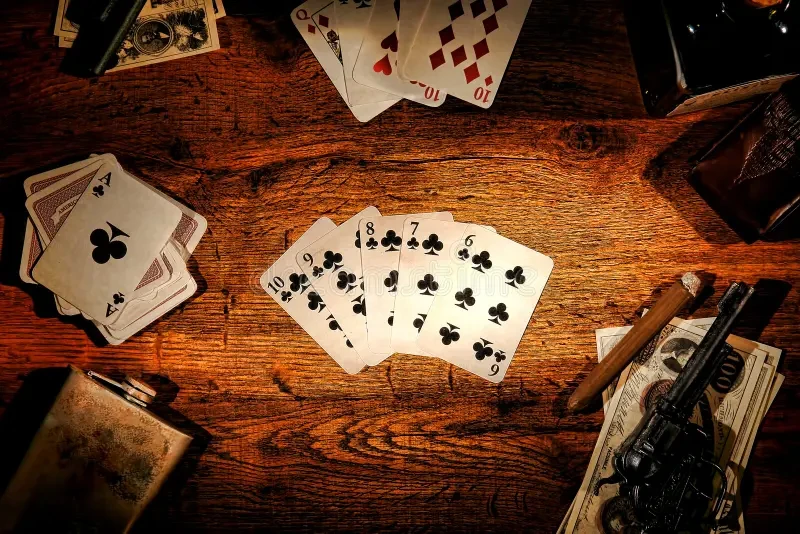
Have you seen a movie scene with players in a saloon set in the Wild West? Chances are extremely high that what you saw was a Five-Card Draw poker game in action. In this game variant, players are dealt five private cards, and there are no community cards to anticipate. There are two betting rounds in the entire hand, with the best five-card poker hand emerging as the winner.
Unlike casino versions, the Five-Card Draw involves competing with another human player. And since all cards are hidden, you’ll need to read your opponents, albeit in this case, psychological play is quite minimal.
An interesting innovation with this poker variant is that you have the opportunity to discard and replace any number of cards from your hand before the second betting round. It would help to mention that Five-Card Draw can be very fast-paced.
Five-Card Draw rules
Before we dive right into how to play 5 Card poker, it is essential to remember that it is a draw game. And what this means is that players can exchange one or more of their cards. It is also played with an ante rather than blind bets, much like most casino variants. Each player posts an ante, and the dealer deals five cards face down to each player.
Next up, below are the stages involved in a Five-Card Draw game:
- First betting round: Players look at their cards and decide whether to bet, raise, call, or fold, depending on house rules.
- Draw: At this stage, players have an opportunity to discard up to their entire five cards and receive replacements from the dealer. While this phase may seem like it is ultimately dependent on luck, a lot of strategic thinking goes into the process of determining which cards to keep or throw away.
- Second betting round: After all draws have been completed, a second round of betting takes place. Players can further choose to bet, call, raise, or fold.
- Showdown: Every player who has not folded would reveal their hands at this point. The best five-card poker hand of them all wins the entire pot.
One key takeaway from this game variant is to keep high pairs or better. You shouldn’t break up made hands unless you’re confident of drawing for a straight or flush. Also, with all the cards hidden, it is important to master the art of bluffing.
Lowball with Ace to Five
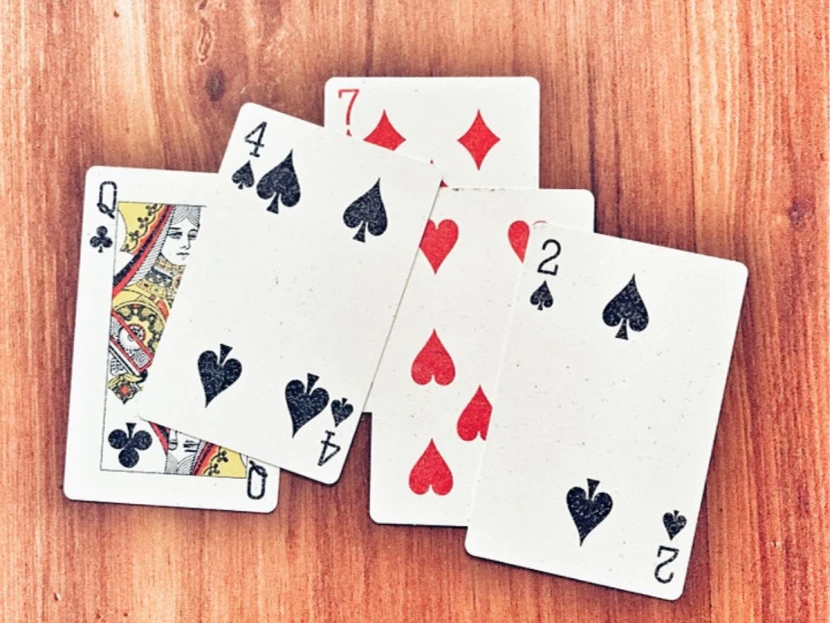
Also called Ace-to-Five Lowball, this poker format aims for players to make the lowest possible hand. In this game version, the best possible hand you can make is A, 2, 3, 4, and 5, hence the name “Ace to Five.” The hand combination is called the “wheel.”
In Lowball with Ace to Five, straights and flushes do not matter for much, and aces are typically low. Also, unlike traditional poker rules, pairs, trips, and higher cards will count against you. Having suits in a hand is also almost always irrelevant unless there is a tie to break. So, for instance, a hand with 7,5,4,3, and 2 will beat one with 8,6,3,2, and A.
On the positive side, Ace-to-Five Lowball is often played as a draw game, so you have the option to discard and draw once during the round.
Lowball with Ace to Five rules
The goal in this poker variant is to make the lowest unpaired hand possible. Here, hands are ranked from the highest card down, with pairs, trips, and high cards effectively worsening your hand.
Depending on the players, the game can be played as a single-draw or triple-draw event. To start with, players receive five cards and have to discard and draw cards to improve their hands. Such draws can happen once or up to three times, depending on the variant. After the draw, there are no multiple betting rounds, and the player with the lowest qualifying hand wins the pot.
While they may appear similar, Ace-to-Five Lowball is different from the 2-7 Lowball poker variant. One of such notable differences is that in the 2-7, straights and flushes count against you while aces are high. The best possible hand you can land in the 2-7 Lowball is, as the name suggests, 2,3,4,5, and 7.
Highway Poker
Finally, on our list is Highway Poker, another casual home game variant. But in this case, there are no fixed or universal rules, and house variations are a common phenomenon. Unlike the others we’ve uncovered, the Highway Poker version features a row of community cards called “the highway.” These community cards are usually laid face-up in a line across the table.
At the start of the game, each player receives up to four hole cards and combines them with cards from the highway to form their best hand. In some cases, players may be required to use one card from each highway lane or choose three consecutive highway cards. Since there are no standardized rules, players typically agree among themselves on how the highway should work.
Betting rounds in Highway Poker occur before and after the community cards are dealt. This rule is one of the few takeaways adapted from Texas Hold’em into the game. Overall, this game prioritizes collective decision-making and community strategy.
Highway Poker rules
Perhaps the most informal of all poker variants, the rules of this game are not cast in stone. One version of the game would probably play out as follows:
- Two hole cards are dealt to each player.
- Players bet at this point.
- A line of seven community cards facing up forms the highway.
- Each player is to select a card from the far left of the highway, one from the far right, and one wild card from the middle of the highway.
- Another betting round occurs at this stage.
- Players build their best five-card hand from the hole cards and their three highway cards.
Without a doubt, Highway Poker combines the best of both worlds—lighthearted gameplay with a good mix of strategy.
Best casinos for playing poker online for real money


Conclusion
Poker is a remarkably diverse game, a characteristic it has maintained for nearly four centuries now. The different types of poker offer something unique, whether it’s a bespoke level of strategy or a special appeal to a distinct audience. And true to its variants, the type of poker you choose shapes your experience, be it a high-stakes tournament, playing against the house in a casino, or having a laid-back home game with your friends.
From strategic staples like Texas Hold’em and Omaha to quick-fire casino games like Three Card Poker and even exotic formats like Highway Poker, there’s a choice of poker games out there for you. However, an understanding of the different variations, rules, betting structures, and hand rankings is necessary for a more enjoyable adventure.
So, if you’re new to the world of poker, we recommend starting your journey with our dedicated guide “How to Play Poker.” This one-stop article covers the basics, betting flow, key terms, and tips to help you play smarter with confidence.
