

How to Play Poker — Basic Rules, Terms & Guide for Beginners


Tracing its recent origins to the early 19th century, poker is one of the most popular card gaming options enjoyed by millions across the globe. Although the game looks quite complex from the outside, experts know that it is very simple to learn.
One of the elements that further makes poker uniquely appealing is how much it depends on skill, strategy, and psychology rather than just pure luck. Interestingly also, the game has evolved from a single standard card deck with mechanical rules to having multiple thrilling variants. Arguably, the most popular of these variations is Texas Hold’em poker.
In this article, we explore all the fine details about how to play poker, walking you step-by-step through rules, terminologies, and strategies. And once you’re ready to learn about other casino games, our dedicated article comes highly recommended.
What is poker?
Many historians believe that poker developed from the French game of poque and the German game pochen. Both of these were card games that involved some form of bluffing and betting. After the Civil War in the United States, the game spread across the country, especially in saloons and gambling halls at that time.
Since then, the world has seen different poker variants emerge, including stud and draw poker. There have also been global tournaments dedicated to players such as the World Series of Poker (WSOP), which is renowned for its massive cash prizes.
Now, what is poker? The central idea behind a game of poker is to either hold the best hand of cards at showdown or convince other players to fold. Ultimately, poker is different from other card games like blackjack and baccarat as, in this case, you bet against other players and not the house.
At the start, each player is dealt a set of cards, and bets are made. Throughout the game round, you can call, raise, or fold until a winner is determined. Winners are chosen by the quality and strength of their card combination, otherwise known as hand, depending on the rules of the variant.
Speaking of variants, there are quite a number of them at online casinos today. However, the popular options remain Texas Hold’Em, Omaha, Seven-Card Stud, Five Card Draw, and HORSE, which is a mixture of different variants.
Articles Worth Reading
Basic concepts and terminology
Every sport or game has its own distinctive rules or terms, and poker is no exception. For instance, in soccer, there are terminologies like offside, penalty, throw-in, and foul that express different rules of the sport.
In any case, now being fully aware of the key terms could make even players with great potential struggle with basic aspects of the game. But on the flip side, being fully aware of mechanics, instructions, playbooks, and the unique language that is used in poker, you can more seamlessly blend into the gameplay experience.
Additionally, considering that poker relies heavily on strategy and psychology, a better grasp of the rules can help you communicate better with your opponent and make more informed decisions. That said, here’s your answer to the common question of what are the rules of poker.
Betting and actions
Like with most casino games, poker requires you to bet for real money. However, the betting process isn’t always entirely straightforward, especially for newbies. Not only are there different ways to bet, but each of these steps has a special terminology that makes it simpler to communicate your intention to others at the table.
Very quickly, let’s run through all the different possible betting actions that you can take while playing poker.
Check
A check is an action that allows a player to pass on the turn to the next player without placing a bet. By checking, you’re essentially saying that you don’t want to bet, but you don’t want to fold, either. However, it’s worth noting that the check action is only possible if no other player has made a bet during that round.
Call
In a call, the player involved tries to match the current bet in a bid to stay in the game. This action is usually taken by the second or subsequent players to wager in a poker round. So, instead of folding or raising the bet amount, the player indicates an intention to put up the same amount of chips or money that some other player has already bet.
Raise
Should you decide not to match the current bet, you can increase the stakes by making a raise. This betting action simply means increasing the amount of chips or money you bet relative to the other player. It is one proven way to mount pressure on your opponent. There is also the option to re-raise, in case someone else has raised the bet before you.
Fold
As the name suggests, a fold means calling it quits and discarding your cards. When you fold, you exit the round and cannot make a re-entry, regardless of what cards eventually turn up for you. Players typically fold when they know they have the weakest hand or suspect their opponent to have a much stronger hand.
All-in
Going all-in means you want to bet all your remaining available chips on a single hand. Once you are all-in, it’s impossible to take any further betting action. Nonetheless, you can still win from the portion of the prize pot that you contributed towards.
Don't Miss Out
Positions and structure
In poker, there are special terms that are used to represent your seating arrangement and its influence on the game’s outcome. Up next, we consider what role your position at a table plays in determining whether you win or lose.
Button
Often called the dealer button, this position marks the player who acted as a dealer for the round, even in games that have a dedicated dealer. It further determines the order of betting, which is typically clockwise, starting from the player to the left of the button.
Blinds
It’s not uncommon to see newbies ask: What is a blind in poker? Simply put, it’s a mandatory bet that two players must make before any cards are dealt. Blinds can be small or big, with the small blind being posted by the player to the left of the dealer and typically half the minimum bet. On the flip side, a big blind is posted by the player two seats to the left of the button, and the amount is equal to the minimum bet in the round.
Ante
Another mandatory bet, this time around, the ante is placed by every player at the table before the hand begins. This ante creates the initial pot for the game and is typically made in small amounts.
Pot
The pot represents the total amount of chips or real money that players have wagered during a hand. Each time a player calls, raises, or places any other bet, the chips are accumulated in the pot. And at the end of the game, the winner walks away with all or a portion of the pot.
Community cards
These are shared cards on the table available for the use of all players in conjunction with their private cards. Community cards are placed face up and, in variants like Texas Hold’Em and Omaha, they are dealt in three stages.
Flop
Remember the stages of dealing community cards? Flop is the initial stage, and it involves the first three community cards dealt face up. Before the flop, a player is dealt two private cards in what is known as the pre-flop. Afterward, a first round of betting occurs, then the flop, and a second round of betting characterizing the post-flop.
Turn
The turn is the fourth community card, also dealt face up. It is sometimes referred to as Fourth Street by expert players. After the turn is a third round of betting, and up comes the river.
River
What is the river in poker? Well, a river is the fifth and final community card, and it is dealt face up on the table. After the river is dealt, there is usually one round of betting left to determine the winner.
Hole cards
It’s just a fancy name for the private cards that each player is dealt. Unlike community cards that can be seen and monitored by the entire table, you’re the only player who can see your hole cards.
Psychology and play style
Poker has some psychological flair to it, no thanks to the mind games that players throw across the table. At the core of each round is a test of patience, perception, and emotional control. Interestingly, the game of poker has behavioral terms used to describe the different mental states of players. They are as follows:
Tilt
A tilt is used to describe a player who has lost every ounce of emotional control. Players typically get tilted after a loss or an unlucky hand. As the game progresses, they tend to make rash and impulsive decisions like raising recklessly, over-aggression, or loose play.
Slow rolling
Ever wondered what is slow rolling in poker? Well, this phenomenon occurs when a player deliberately delays revealing his winning hand at showdown. Most players do this to annoy or embarrass the opponent. Although not illegal, many people consider it a sign of bad sportsmanship.
Bluff
Perhaps one of the most used psychological terms, a bluff is the act of presenting a facade. When bluffing, players usually bet or raise with a weak or marginal hand with the intent of making opponents fold stronger hands. The bluff is a weapon rooted in confidence, pinpoint timing, and reading your opponents.
Trap
A trap occurs when a player pretends to be weak despite having a strong hand. The intention here is to lure opponents into betting or raising, and subsequently raising the pot for you to win the round.
Nit
Nits are players who are very risk-averse and super tight. They play only the strongest hands and avoid marginal spots. The predictability of this gameplay makes it hard for nits to win big pots.
Fish
What is a fish in poker? Well, a fish is a newbie, an inexperienced player who consistently makes bad decisions. Everyone starts out as a fish, but the key is to be patient and learn as fast as possible.
Technical terms
There are other technical terms in poker worth considering. Here are a few of them:
- Hand: A hand is a combination of cards held by a poker player.
- Deck: This refers to a standard set of 52 playing cards.
- Showdown: The showdown is the point where players reveal their hands after the end of all betting rounds.
- High card: A high card is a hand without a pair, ranked by the highest card.
- Straight Flush: This refers to a combination of five consecutive cards of the same suit.
- Royal Flush: Here is a straight flush that comprises cards from 10 to Ace.
- Kicker: It’s a side card that is used to determine the winner where two or more players have hands of the same rank.
As you progress, you’ll learn some more complex terms, but for now, these technical terms should get you started on your journey.
How to play poker

The general principle of poker is simple: players compete to win the pot by playing the strongest hand or forcing all other players to fold by the showdown. However, the many ways players take to attain this objective can be divergent. Let’s chart the process of a poker round from start to finish, shall we?
At the start of each hand, players make bets, all of which contribute to the pot. Initial bets come from blinds and antes, but the pot ultimately grows as players make voluntary bets, raise, or call during the rounds.
With the pot active and ready for the taking, here’s a look at the several stages of play:
- Pre-flop: This stage comes right after players receive their hole cards face down. Players then decide to fold, call, or raise based on their starting hands.
- Flop: During this stage, three community cards are dealt face up on the table. Another round follows where players can check, bet, call, raise, or fold.
- Turn: Here, the fourth community card is revealed, after which a third betting round follows. It is very common for the stakes to reach an all-time high here.
- River: The fifth and final community card is dealt during the stage, with this final betting round giving players the last chance to either fold or bet.
- Showdown: If at least two players remain, everyone reveals their cards. The player with the best five-card hand wins.
As an example of how a hand plays out, imagine a Texas Hold’Em game with four players. Each player gets two hole cards. In the pre-flop, Player 1 raises, Player 2 calls, and the others fold. The dealer goes ahead to deal the flop. Afterwards, Player 1 bets again while Player 2 calls. The turn card is dealt, and another betting round follows with Player 1 betting and Player 2 folding.
Given this run of play, Player 1 wins the pot without needing to reveal his cards at showdown.
Tips to play poker like a pro
No one becomes a pro at poker overnight. The game is crafted in such a way that you need a blend of strategy, experience, and, of course, luck to become a remarkable player. However, all hope is not lost for beginners. Depending on how quickly you can learn and adapt your skills to actual gameplay, you can start off on the right foot, even as a newbie.
That said, if you’re out to discover how to play poker simple but smart, then you’ll need to follow our straightforward yet effective recommendations. Our carefully curated essential tips are designed to help you avoid common mistakes, read the table, and make confident, consistent decisions even under pressure during a round.
Ready to improve your performance right from the start? Here are some concepts to put in mind.
Consider your position at the table
One of the strategic aspects of poker is the positioning of players at the table. As we’ve discussed in the previous sections, your seating affects how much of the game you can manipulate. For instance, players seated to the right of the dealer often play last and, by then, must have gotten information about the actions of other competitors at the table.
If you’re caught in that juicy spot, you can bluff more often and play quite aggressively. But on the flip side, sitting in one of the earlier positions means you need to be cautious and only play the strongest of hands. Players in the middle will need to be more aware while leveraging the limited information available to them.
Stay calm and don’t play on emotion (avoid tilt)
As a poker player, your mental strength is as important as the quality of your cards. Experts of the game are those who have learned to control their emotions and stay calm even under the worst of pressures. While bluffing is a key tactical skill, you also need to learn when to stay calm and read your opponents in a bid to save your chips.
Besides, losses can sting, especially when you think you finally have a grasp on the gameplay. However, remember that even the most experienced of players sometimes lose hands or even million-dollar tournaments. So, don’t go chasing losses and handle them without aggression or giving in to impulse. Often, the best strategy is skipping a few hands to regain control.
Pay attention to your opponents
There are several skillsets that separate top players from noobs, and another essential one is the ability to “read” opponents. With one eye on the card and the other eye on the table, the skilled poker genius pays close attention to the behavior of other players.
By observing, not only do you get to read their body language, but you also gain insight into their strategy, information you can use to your advantage. You should watch for betting patterns, the amount of time taken to bet, confidence, and even their aggressiveness.
Learn to label your opponents across different traits and leverage this knowledge to adjust your strategy accordingly.
Manage your bankroll wisely
It is always pivotal to wager responsibly at a poker table. That’s why learning proper bankroll management before you start betting for real money is a foundational requirement. With a good bankroll management system, you can divide your entire portfolio into small bet sizes (5–10%) and play at intervals. That way, you can better manage your risk exposure.
In addition, good bankroll management helps you earmark a certain amount for your poker and general gambling activities. This system ensures that you don’t dip into cash that’s meant for other uses, such as your upkeep, utility bills, or emergency funds. And since you only stand to lose a tiny fraction of your total financial base, you’re at a low risk of getting burnt or bankrupt from poker.
Mix up your playing style
Predictability is the bane of most poker players. Having learned one strategy that works, they find it hard to deviate from it or vary their style of play. Sadly, this lack of flexibility ultimately becomes their nemesis as it won’t take long for opponents to discover the strategy and reverse engineer it to their advantage.
That said, it is important that you vary your playing style and make it extremely difficult for others to anticipate your next move. A bluff with a weak hand here, a passive momentum with a strong combination, and some aggressive play other times make for the perfect mix.
Know the rules and terms 100%
Regardless of your level of experience or expertise, there’s no end to going back to the basics. All of the terms and rules you learn as a newbie will always be relevant, even at high-reward tournaments. So, don’t lose sight of introductory details. In fact, the best players are those who have an automatic recall of bet types, positions, and other technical terms.
Understanding the fundamentals will provide a solid foundation for your advanced tactics and make you more strategically positioned to level up.
How to play poker online
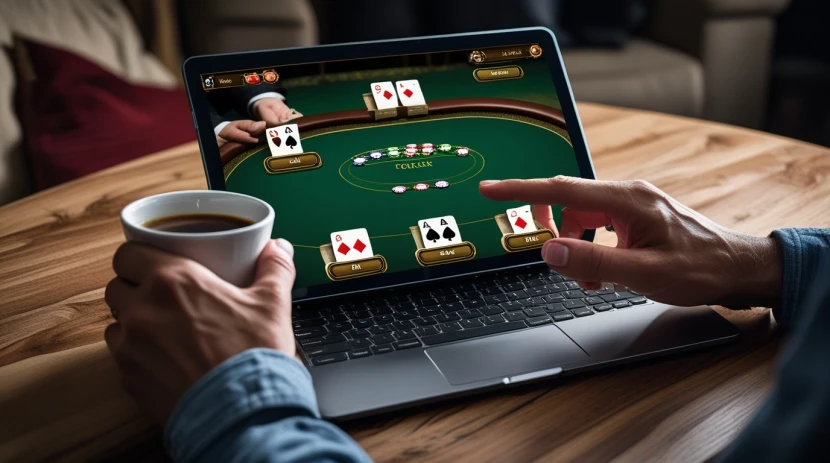
Playing poker at a physical table is intriguing in its own right, but learning how to play poker online presents a special challenge. While playing poker online follows the same core rules as traditional poker, you lose out on the physical elements here.
In online poker, you can’t maintain eye contact or watch for subtle clues like nervous habits or facial expressions. Similarly, online poker moves at a faster pace because there is no physical chip handling involved. That way, you get to play more hands per hour and can even choose to play multiple tables simultaneously.
For a more realistic experience, many modern casinos now offer live dealer poker tables that combine the speed and convenience of online poker with real-time competition against other players.
Best casinos for playing poker online for real money


Conclusion
Poker has transcended the status of a mere casino game; it is now a core part of pop culture. The card game combines an exciting blend of strategy, psychology, and chance, being one of the few casino games that offer this salad of human exertion.
Even better, the versatility of poker is outstanding. You can enjoy it with friends on a Friday night or win thousands of dollars from it at a World Series of Poker competition. But regardless of where you choose to play, remember that poker involves more than waiting for a winning hand. It is all about making consistently smart decisions and staying in control of tough situations.
As we close out, remember that poker is like every other form of gambling. It should be played responsibly and with awareness of the different risks associated. With that in mind, don’t forget the core principles of the game, and stay armed with our effective gameplay recommendations.
